Poridhi.io
Transforming DevOps education from theory to hands-on cloud experience
- Role
- Product & UX Designer
- Duration
- Jan 2024 – Aug 2025
- Industry
- EdTech
- Team
- Product team of 5
- 42%
- Higher lab engagement · vs previous platform
- 70%
- Improved confidence with AWS tools
- 1,000+
- Concurrent learners supported
- 85%
- Module completion rate
Overview
My role: product & ux designer.
Owned end-to-end product design strategy, creating an immersive lab experience system with integrated tools and measurable progress tracking.
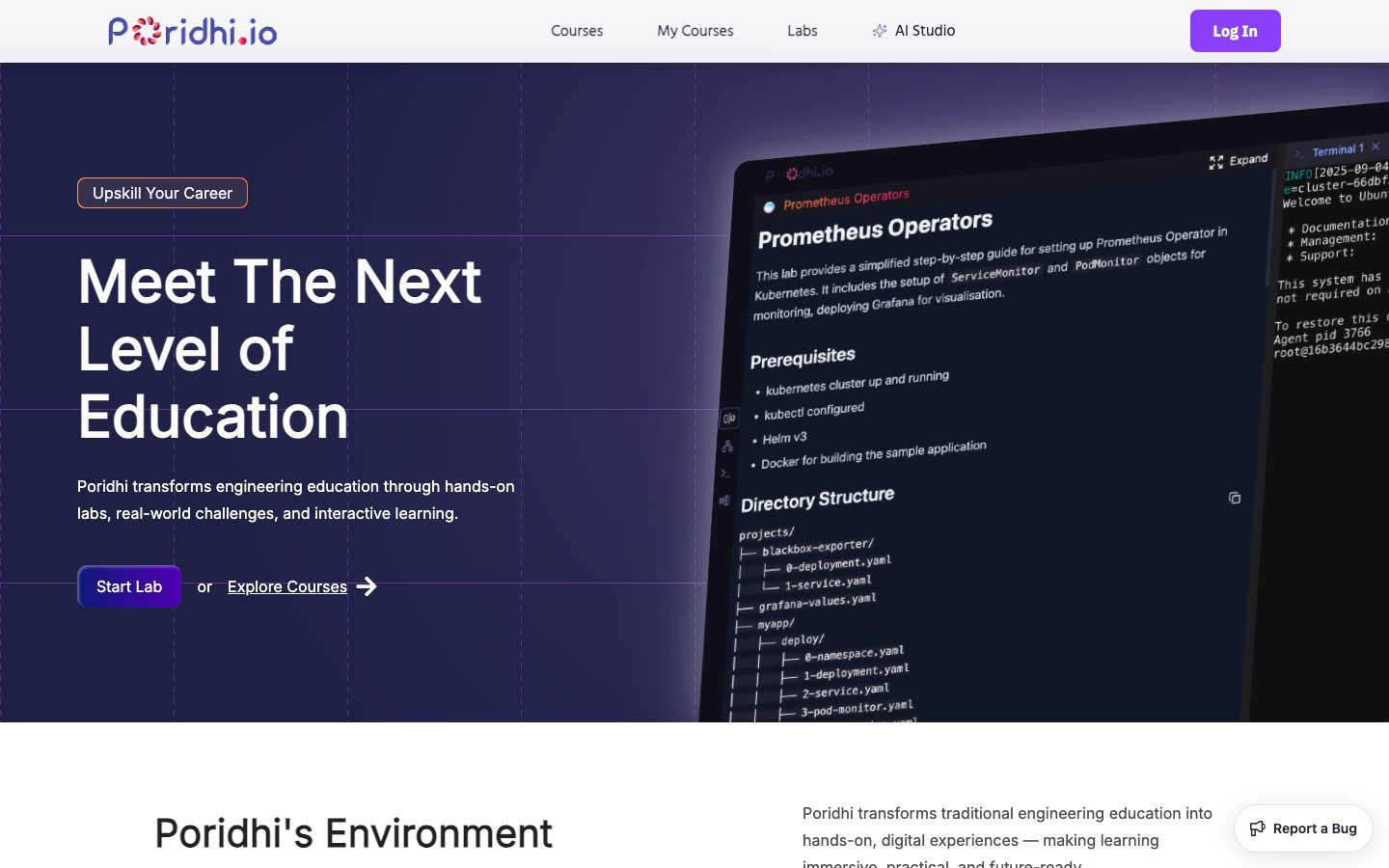
Poridhi.io is an EdTech platform focused on DevOps and cloud engineering education. The project aimed to turn theoretical learning into practical, hands-on experience using real cloud environments and integrated development tools.
- R.1Conducted interviews with 30+ learners to identify pain points
- R.2Designed the Lab Experience System with CLI, IDE, and cloud simulator
- R.3Created a module-based content architecture
- R.4Simplified complex workflows into visual step-based journeys
- R.5Developed a scalable UI supporting concurrent learning
The problem
Students were learning DevOps and AWS through passive video content without practical experience. Traditional platforms lacked interactive lab experiences, making it difficult for students to gain job-ready skills and confidence with real tools.
Constraints
- C.1Need to support 1,000+ concurrent users
- C.2Complex cloud infrastructure integration
- C.3Real-time CLI and IDE performance requirements
- C.4Budget limitations on cloud resources
Approach & decisions
What I decided, and why.
Process
8 steps from brief to launch.
- 01Learner Interviews (30+)
- 02Pain Point Analysis
- 03System Architecture Design
- 04Lab Experience Prototyping
- 05Usability Testing
- 06Iterative Refinement
- 07Scalability Testing
- 08Phased Rollout
Interface
Designed to convert.
Integrated development environment interface
Module-based progress tracking system
Real-time feedback and error messaging
Step-by-step visual guidance for workflows
Responsive layout for all screen sizes
What improved
- Hands-on learning vs passive watching
- Real-time practice with cloud tools
- Clear progress visualization
- Scalable architecture for growth
Before
Students were learning DevOps and AWS through passive video content without practical experience. Traditional platforms lacked interactive lab experiences, making it difficult for students to gain job-ready skills and confidence with real tools.
After
The platform turned passive learning into hands-on practice. Students now work through real DevOps workflows in simulated cloud environments, with 42% higher lab engagement and an 85% module completion rate.
Outcome
The platform turned passive learning into hands-on practice. Students now work through real DevOps workflows in simulated cloud environments, with 42% higher lab engagement and an 85% module completion rate.
Visit the live siteNext case study
Charlotte LED Pros